Pages

Showing posts with label Classic. Show all posts

Wednesday, 8 June 2016

Some Classic Passionate kisses of 1900s

Collaction of fantastic Kisses captured while people were having passionate moment with their love.. 

1.Protest in whole new style.
oldclicks.blogspot.in
Protest

2. A Perfact Summer Vacation Kiss.

Beach Kiss

3. On Duty Kiss.


On Duty

 4. Man Got Her In Backyard.


Backyard 

5. Wohooo... Romance in Rain.


Romantic Rain

6. Girlfriend giving bye-bye Kiss to her Boyfriend.


Sandoff

7. An Officer gives a Perfect Treatment.

Officer On Road

8. A Girl jump on her Boyfriend with Ecstasy.


Passionate

Wednesday, 19 August 2015

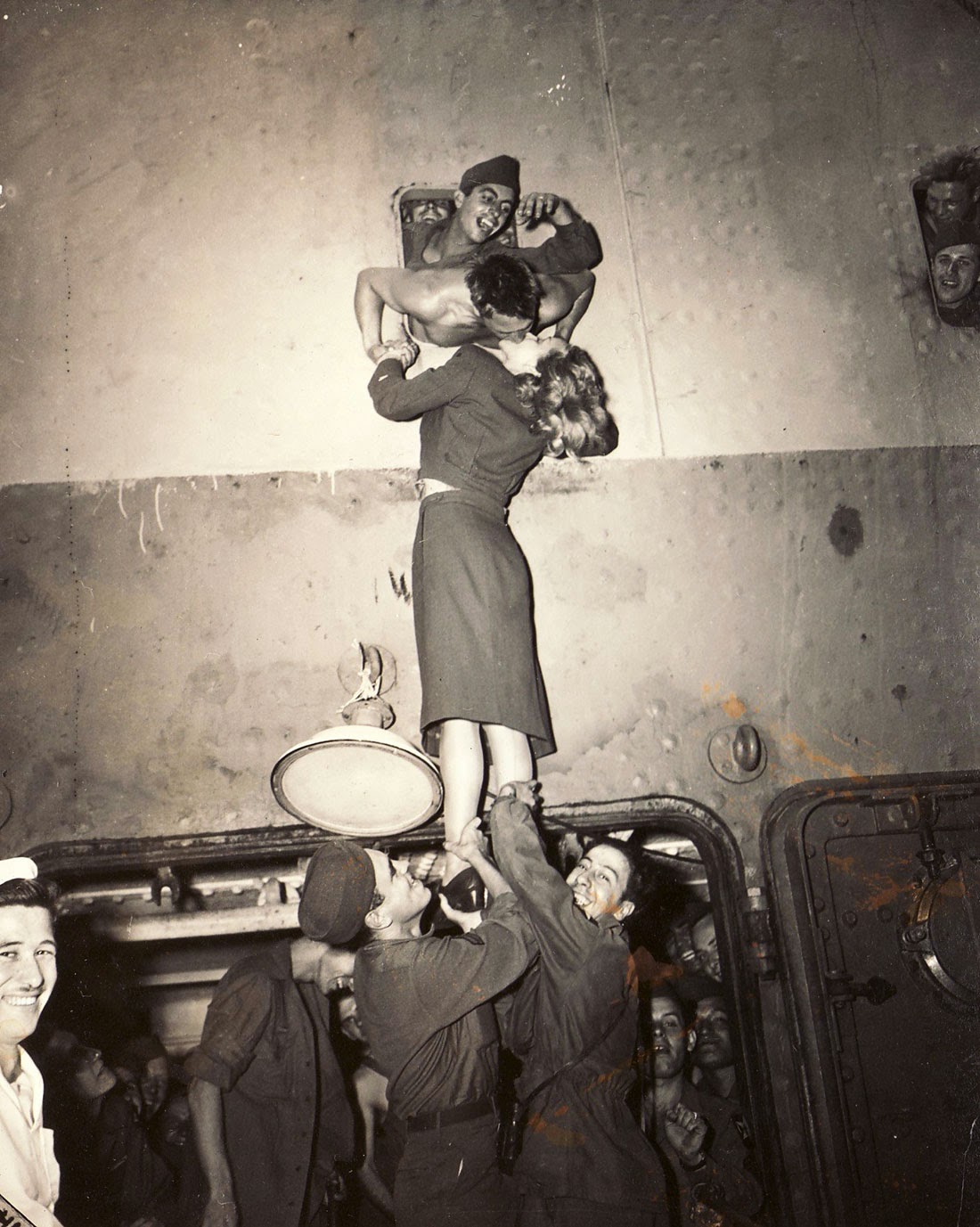
Actress Marlene Dietrich kisses a soldier returning home from war, 1945


https://blogger.googleusercontent.com/img/b/R29vZ2xl/AVvXsEha6qYKla3_s60Du5giB-v_ZmcFgnq0a8dmdM9GuUFyWgCfSBW37dIuF6dT06d-lgc3D6KodsTs9GkfXENkcL_Teu3pf5gbYv-1VnRk0W1FQXW2AVD-cVNANEMA90yvA6vBCN-k6mvkVDwR/s1600/Actress+Marlene+Dietrich+kisses+a+soldier+returning+home+from+war,+1945.jpg
It seems that the guy on the left holding her up is enjoying the view.


This photo shows Marlene Dietrich passionately kissing a GI as he arrives home from World War II. It seems that the guy on the left holding her up is enjoying the view. It was first published in Life Magazine with the caption: “While soldiers hold her up by her famous legs, Marlene Dietrich is kissed by a home-coming GI”. Photo taken by Irving Haberman.

The ship was the Monticello, a converted cruise liner. Her original name was SS Conte Grande and was built in 1927 in Trieste, Italy. During World War II, she was acquired by the United States and was used as an American troopship—renamed USS Monticello (AP-61) in 1942. At the time the photo was taken it was transporting parts of the 2nd infantry division home.


https://blogger.googleusercontent.com/img/b/R29vZ2xl/AVvXsEjMYDlkUCdG8S41itXUeJlPP_u5ngRIvk0VTXBsndNk3zxf_OXR5yo_YmyyGueXE6_aDa3J7KxWRywRleZiQtqCiOobDQ1EeOHZtlizOSHXE7r2ONavufJz5CWpphSZ2bqom27QxMbhydTd/s1600/Actress+Marlene+Dietrich+kisses+a+soldier+returning+home+from+war,+1945+(2).jpg
Marlene Dietrich (1951).
The 2nd division soldiers had entered the war in Normandy on D-Day. They fought across Europe into Czechoslovakia. They arrived in New York (when this photo was taken) on July 20, 1945. The war was not over for them. They were on their way to Camp Swift in Texas for training. They were supposed to be a part of the invasion of Japan.

Marlene Dietrich has a curious story. She was a German actress and singer. Her cinematography life started in Germany and later in Hollywood where she became very famous. Dietrich was known to have strong political convictions and the mind to speak them.

In interviews, Dietrich stated that she had been approached by representatives of the Nazi Party to return to Germany but had turned them down flat.

Dietrich, a staunch anti-Nazi, became an American citizen in 1939. In December 1941, the U.S. entered World War II, and Dietrich became one of the first celebrities to raise war bonds. She toured the US from January 1942 to September 1943 (appearing before 250,000 troops on the Pacific Coast leg of her tour alone) and was reported to have sold more war bonds than any other star. At the end of the war she was awarded the highest American civil medal: the Medal of freedom.

Monday, 22 June 2015

An American Odyssey: Stunning Color Photos of the US from the Late 1800s

Mulberry Street, New York

These rediscovered Photochrom and Photostint postcard images from the private collection of Marc Walter were produced by the Detroit Photographic Company between 1888 and 1924.
Using a photolithographic process that predated the autochrome by nearly 20 years, they offered people the very first color photographs of The United States. Suddenly, the continent's colors were available for all to see. The rich ochres and browns of the Grand Canyon, the dazzle of Atlantic City, became a visual delight not only for eyewitnesses, but for Americans far and wide.


https://blogger.googleusercontent.com/img/b/R29vZ2xl/AVvXsEhbbgT-aKWKeHfSZFfZjQoF8P7wpjpCdaDzNrmi-PA4pLDmH-JnNn9BE3UgVhifmpbZiShIsQIvBbCwnv7GqmDRBNTktNvw_Zg_KWlqZvzNeI0W7kAjrUtry_SGJ2h_h99Nyk-iiXk2RL4/s1600/American+Odyssey+%25283%2529.jpg
Zuni people, the rain dance, New Mexico
Mount Lowe railway, on the circular bridge, California  
Magnolia-on-the-Ashley, Charleston
https://blogger.googleusercontent.com/img/b/R29vZ2xl/AVvXsEi_6UEE2yy6fod09VVUCSCfoWEGSRD0gyVh4WLuE8F1rtoV2m-zN-KtyZBAnKFJ34hSuGn6NMNU7FRFAbykuwapZWs8RSWbmfKRa3UBTkyz9qFwWcjT2uqJl3ER2kwNpFbvhZ1lMb8M8VU/s1600/American+Odyssey+%25288%2529.jpg
Diving for coins, Bahamas 
Members of the Seminole Tribe in Florida
Clear Creek Canyon, Georgetown loop, Colorado
Mariposa Grove, 'Three Graces', Yosemite national park, California

Grand Canyon, view from O'Neill's Point, Arizona        


Rarely Seen Candid Photos of Charlie Chaplin While Filming on Venice Beach, California, ca. 1914


https://blogger.googleusercontent.com/img/b/R29vZ2xl/AVvXsEhnUPHxuhd3AnM8GlR7n5NdaCoGM90ItplFEj1NzuMordspteTH6ZHUEzhFi67TOhqMxj9eIKoo18DjaJvcP2gOJAiRBPx3RPPcc-UrA25tDTD__hznQd_fKW6dmAgVqWbnRPDjNYUHQd4/s1600/Charlie+Chaplin+on+Venice+Beach%252C+California%252C+ca.+1914+%25282%2529.jpg

These rarely seen photographs may be from on-site at the shooting of 1914 silent film Kid Auto Races at Venice (also known as The Pest) on Venice Beach, California. 

This is an Essanay Studios film starring Charlie Chaplin in which his "Little Tramp" character makes his first appearance in a film exhibited before the public.

https://blogger.googleusercontent.com/img/b/R29vZ2xl/AVvXsEjioptjLmUdS7KGF0IZyJGIqAzYjWIODxZsgaA37Ar25xP0uwgdd-huqBGwc9YhIYU3awuiQgKPYy4mIszyJ1W_cssyS_Je7r_Tdw1k4TyJbODFdREgOsAtMnaA0q63q94JAb1NR0VqWZg/s1600/Charlie+Chaplin+on+Venice+Beach%252C+California%252C+ca.+1914+%25281%2529.jpg


https://blogger.googleusercontent.com/img/b/R29vZ2xl/AVvXsEjMX41y9mc8st741_58QdghlVdr7RyBVCsLQhwjAeWCxgp4oQOSdeOuz823g1oHc5HzdTsO61zUrb6l8RZaoq0wgvXW576bea6DP7BJu3z2SsaJTl5vmdvBtvc0fWqDtuuH3RV_snZYADw/s1600/Charlie+Chaplin+on+Venice+Beach%252C+California%252C+ca.+1914+%25283%2529.jpg

Thank You


Saturday, 20 June 2015

India’s Earliest Photographs-Royal collection

A Group of Royal Women, Including Chandrawati Holkar of Indore, her daughter Manorama Raje and Indira Devi of Cooch Behar. Circa 1920.


Maharajah Sardar Singh of Jodhpur. Circa 1890.


Madura, No. 6. A Passage in the Temple (Kilipputtu Muntapam). 1878.


Maharajah Bhan Pratap Singh of Bijawar. Central India. Circa 1882.


The Golden Temple at Amritsar. 1860s.


Hullabeed: The Great Temple, Southern Door in East Front.


A Holy Man Wearing Flower Garlands. Circa 1890s.


A Shaiva Yogi Seated on a Tiger Skin. Circa 1890s.


Maharajah Yeshwantrao Holkar II. Circa 1930.


Maharajah Tukoiji Rao Holkar III’s Wedding Procession. Indore. 1913.


Dewas Athletes. Circa 1885.


No. 176 – Caves of Karlie: No.1. The Approach. Western India. 1855-62.


The Maharao Raja of Bundi. 1903.


India’s Earliest Photographs- Gate of MJamuasjid Mosque 1860.


Gate of Jamu Masjid Mosque. Lahore, India. 1860.


In “Three Princes With Attendants,” three young Central Indian princes, perhaps from Gwalior, pose with two attendants, with the youth on the very right blurred by the long exposure. According to Ms. Hutton, “The lavishness of the studio setting speaks to the success that Dayal had achieved by that point in time.”
Other images in the exhibition include prints by a handful of photographers and amateurs who worked in India during the late 19th and early 20th centuries, not long after the East India Company replaced the Mughals as the main power in the north and when rule was subsequently given to the queen of England. These men, some of whom were doctors, took quickly to photography, which was rapidly replacing painting as the primary tool for portraiture and documentation, not long after its invention in Europe.

“The majority of South Asia scholars focus on ancient Indian sculpture and painting, but India’s traditions of modern art are becoming new grist for study and are of greater interest to the large collecting and museum-going public,” said Marika Sardar, associate curator of Southern Asian and Islamic art at the San Diego Museum of Art. “In that way, people are looking more at the practice of photography and its importance in the changing world of 19th-century India.”

For one, photographers at the time were encouraged by each other and by the British raj. And not only was there widespread promotion of the new tools of the trade — daguerreotype cameras were advertised in Calcutta a year after their invention in France — but photographic societies in Bombay, Calcutta and Madras were beginning to pop up from the 1850s onward.

And, according to the Bubbar catalog, “With these societies developed communities that organized events, exhibitions and the publication of journals, fostering an active culture of experimentation and exchange.”
The exhibition includes works by members of those societies, like Dr. John Murray, a teacher and principal of the medical school in Agra, who took up photography around 1849 and began participating in the Photographic Society of Bengal in 1856. At that time, the colonial administration began employing photographers to conduct surveys to document and preserve India’s monuments as well as military sites, specifically after the uprising of 1857. It was with this intention, perhaps, that Dr. Murray was asked by Governor-General Lord Canning to photograph myriad locations related to that uprising, as in an 1858 image of cannonballs in front of the Pearl mosque in Agra.

Similarly, in 1863, John and James Nicholas, who together were known as the Nicholas Brothers, Photographers of Madras, established a studio and concentrated on the South Indian landscape. They produced such works as, “Madura, No. 6. A Passage in the Temple” and “Seringapatam. Mausoleum Erected Over Tippoo Sultan and Haider Ali.” The latter, according to the Bubbar catalog, is an example of a site that interested the British.

One gem in the show, Mr. Bubbar said, is the later Man Ray portrait of Yashwant Rao II Holkar Bahadur, maharajah of Indore.

“He was a gifted and highly sensitive Indian prince, not merely one following the latest fashion,” Mr. Bubbar said. “Man Ray photographed him and his wife on numerous occasions. The image marks a high point of exchange, a cultural encounter.”

Mr. Bubbar, who added that he had been working on curating this show “subconsciously for at least five years,” hopes that with his exhibition he can shed light on an important chapter of Indian history and art.
“The show is a survey of the photographic medium in India from 1855 to 1930, highlighting some key moments,” he said. “I am hoping that people walk away with a sense of the medium’s history, its beauty and its relevance.”

India’s Earliest Photographs


Three Princes With Attendants. Indore, Central India. Circa 1894.


For someone who ended up with the title “Bold Warrior of Photography,” Raja Deen Dayal started out rather cautiously. Instead of quitting his job as a surveyor at the Public Works Department in Indore, India, once he discovered photography in the 1870s, he waited about a decade before taking a two-year furlough to see if he could handle it.


“I suspect he took the two years off to see if he could be successful as a full-time photographer before resigning his position,” said Deborah Hutton, an associate professor of art history at the College of New Jersey and a co-author of “Raja Deen Dayal: Artist-Photographer in 19th-Century India.”


It seemed to work. He became so successful as a full-time photographer that he never returned. Instead, he traveled India, eventually opening up his own commercial studios in Indore, Secunderabad and Bombay, creating over 30,000 images from 1878 until his death in 1905. Meanwhile, he earned the title of Raja Musavvir Jung (loosely translated as Bold Warrior of Photography) from the sixth nizam of Hyderabad, for whom he was a court photographer, before landing a royal warrant by Queen Victoria in the late 1890s.


Works by Dayal are some of the many on view in a new exhibition titled “The New Medium: Photography in India 1855-1930,” a show that runs through July 10 at the Prahlad Bubbar gallery in London.