Pages

Showing posts with label Vintage. Show all posts

Friday, 22 April 2016

Albert Einstein at the beach,1939


David Rothman was in his work clothes and Albert Einstein was dressed for the beach when they posed on this rock at Horseshoe Cove in Nassau Point in the summer of 1939. 
   Pictured here in September 1939, Einstein relaxes on the beach near his Long Island summer home with friend and local department store owner David Rothman. After some initial confusion in the store resulting from Einstein’s thickly accented request for a pair of “sundahls,” which Rothman interpreted as “sundial,” the scientist was able to successfully purchase the white sandals on his feet for $1.35. He laughed off the episode, blaming “mine atrocious accent!” The men remained close friends thereafter, later forming a neighborhood string quartet together.  The original black and white photograph.

 
Einstein was legendary for going sockless.

 In 1939 Einstein rented this cottage on Nassau Point in Cutchogue so he could put his sailboat in Horseshoe Cove. For Einstein Long Island only meant a place where he could enjoy himself. The neighbors said the two main activities Einstein did to occupy his time there were: sailing and violin playing.

Einstein, who never learned to swim, had no pretensions about his nautical prowess. He had named his glorified rowboat the Tinef, which is supposedly Yiddish for junk. It was small, maybe about 15 feet (4.5 meters) or so, and very unprepossessing.
 
Before that summer was over Einstein would sign a letter to President Franklin Delano Roosevelt warning him that the United States couldn’t afford to wait while Nazi Germany was possibly making a nuclear weapon.


Einstein was legendary for going sockless, and this occasion was no exception. He did that because he had a problem with his feet throughout his life, he had flat feet and varicose veins. When he went to Switzerland he was summoned by the military officials for the medical examination. At the medical examination Einstein was attested varicosities, flat and sweaty feet. Thus he was declared “Unqualified A” by the examination committee. The “A” means, that he could only be used for “helpers’ services”. However, the Swiss Army never summoned Einstein to perform these services. Sometimes he found other reasons for not wearing socks. “When I was young, I found out that the big toe always ends up making a hole in the sock,” he once said. “So I stopped wearing socks.”
(Photo credit: Southold Historical Society.)


Wednesday, 30 December 2015

The atomic cloud over Nagasaki, 1945

https://blogger.googleusercontent.com/img/b/R29vZ2xl/AVvXsEgp1n0BUJ2rtmMpW04uros2V67oAlSTtC830guBVxJFcT5QZ6uOopit5J975VOf48b6tUU1fFnMh7E52WyJs916fo52CtkbgPEVYOPFlHon4O2G6p832umD38iJX4tW5leNBuJMHj0mrp7U/s1600/The+atomic+cloud+over+Nagasaki%252C+1945.jpg
The atomic bomb mushroom cloud over Nagasaki on August 9, 1945.


This is believed to be the earliest photograph from the ground, 15 minutes after the plutonium bomb detonated over Nagasaki. The destruction was so incredible that there is no count on how many people died that day. The atomic bombings of Hiroshima and Nagasaki will forever live in the pages of history as two of the most significant turning points in modern history, initiating the world into the nuclear age.

At 03:49 on the morning of August 9, 1945, Bockscar carried Fat Man, with Kokura as the primary target and Nagasaki the secondary target. The mission plan for the second attack was nearly identical to that of the Hiroshima mission, with two B-29s flying an hour ahead as weather scouts and two additional B-29s in Bockscar’s flight for instrumentation and photographic support of the mission. The crew had been expressly ordered to pick out their target visually, rather than by radar, since the explosive reach of the bomb, although astonishing, was still limited enough that to be off by a mile or two might result in the majority of its power being wasted.

After exceeding the original departure time limit by a half hour, Bockscar, finally was over Kokura. The delay had resulted in clouds and drifting smoke from fires started by a major firebombing raid on nearby Yahata the previous day over Kokura. Additionally, the Yawata Steel Works intentionally burned coal tar, to produce black smoke. The clouds and smoke resulted in 70% of the area over Kokura being covered, obscuring the aiming point. After three runs over the city, and with fuel running low, the wing headed for their secondary target, Nagasaki.

Bockscar arrived at Nagasaki at 11:50 A.M. Tinian time, by which point it had been in the air for nearly eight hours. Given the plane’s mechanical problems, the crew were close to the point at which they would have to turn back or risk ditching.

The Fat Man weapon, containing a core of about 6.4 kg (14 lb) of plutonium, was dropped over the city’s industrial valley. It exploded 47 seconds later at 1,650 ft (503 m), above a tennis court halfway between the Mitsubishi Steel and Arms Works in the south and the Nagasaki Arsenal in the north. This was nearly 3 km northwest of the planned hypocenter. The resulting explosion had a blast yield equivalent to 22,000 tons of TNT. The explosion generated heat estimated at 3,900 °C (7,050 °F) and winds that were estimated at 1,005 km/h (624 mph). Forty thousand people died, and another forty thousand were injured, according to the American government’s postwar estimates. The radius of total destruction was about 1 mi (1.6 km), followed by fires across the northern portion of the city to 2 mi (3.2 km) south of the bomb.

Interesting fact:
  • On August 12, the Emperor of Japan informed the imperial family of his decision to surrender. Even though the War Council still remained divided (“It is far too early to say that the war is lost,” opined the Minister of War), Emperor Hirohito, by request of two War Council members eager to end the war, met with the Council and declared that “continuing the war can only result in the annihilation of the Japanese people…”. The Emperor of Japan gave his permission for unconditional surrender.
(Photo credit: Hiromichi Matsuda).

Saturday, 22 August 2015

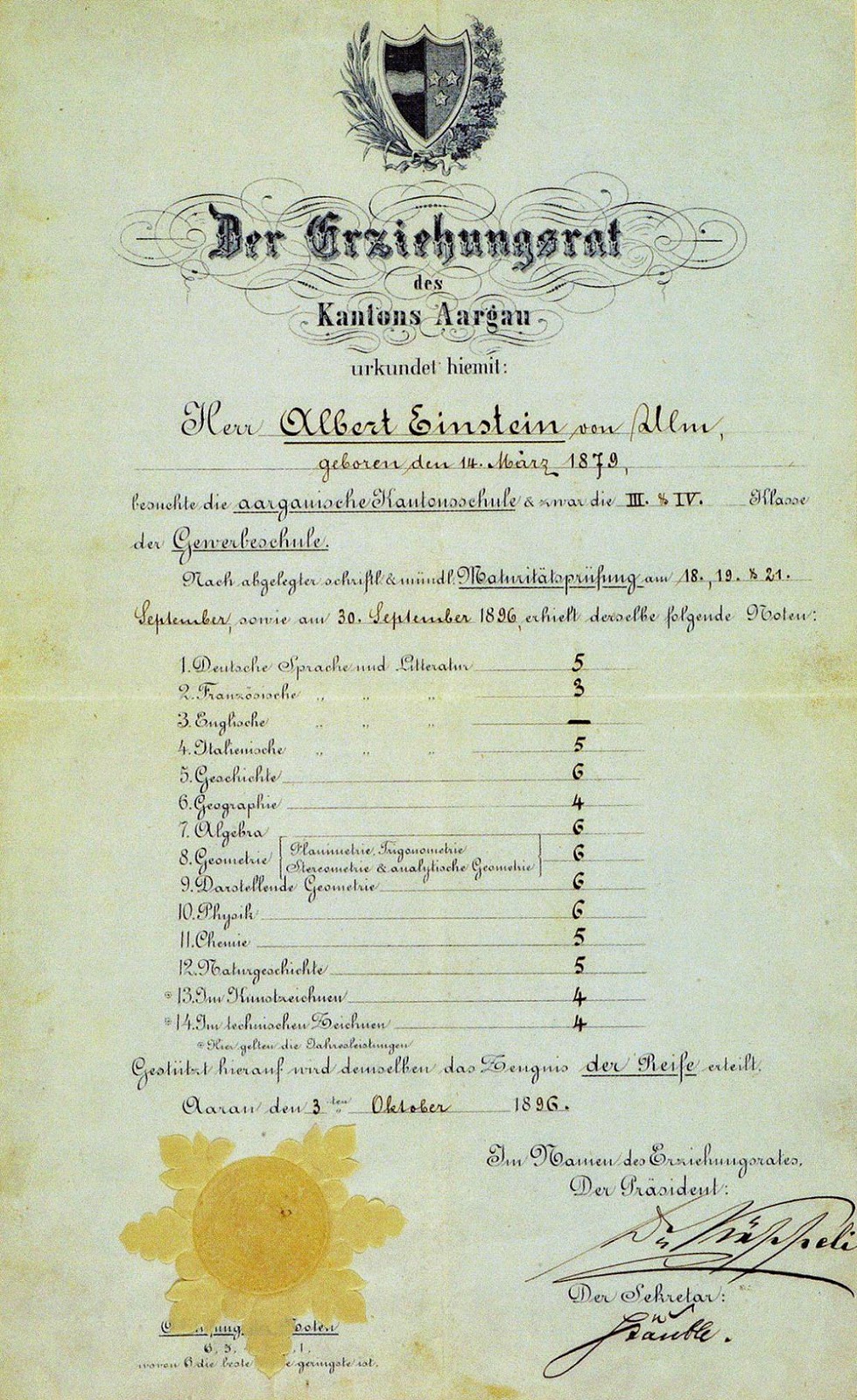
Albert Einstein’s matriculation certificate, aged 17, 1896


https://blogger.googleusercontent.com/img/b/R29vZ2xl/AVvXsEihXl7Z9j7rkTXsZcqYiySVmr6rBDyxBJVXUGZ1sgAEebxTIDYywxTjPthZjV2vPvN571FFmqusKRp0qFQnjB3ereqzk07cx6j8DJssmdo4SG6HY8Q49FFIVrJma9sbUM82-nqDv0dlsITu/s1600/Albert+Einstein%E2%80%99s+matriculation+certificate,+1896.jpg
Albert Einstein’s matriculation certificate, aged 17, 1896. It’s a myth that Einstein was bad at math.

This puts to rest that urban legend that Einstein was a “bad student”, although he received a three in French. He did, apparently, receive straight sixes in algebra, geometry, physics, and – history! Young Einstein knew what was important, it seems. Perhaps the legend is founded in the fact that the Swiss school system has a 6 as best grade, and 1 as poorest, while the German is the other way round. In his certificate of qualification for university matriculation the lessons which he was less interested in can easily be detected. But the average grade in his certificate was a 5, i.e. the grade “good”!

In 1895, at the age of sixteen, Einstein sat the entrance examinations for the Swiss Federal Polytechnic in Zürich (later the Eidgenössische Technische Hochschule ETH). He obtained the best results in the mathematical and natural science subjects, but in the linguistic and historical subjects his achievements were unsatisfactory. His overall result was rated as insufficient. On the advice of the Principal of the Polytechnic, he attended the Aargau Cantonal School in Aarau, Switzerland, in 1895–96 to complete his secondary schooling.

In September 1896, he passed the Swiss Matura with mostly good grades, including a top grade of 6 in physics and mathematical subjects, on a scale of 1-6, and, though only seventeen, enrolled in the four-year mathematics and physics teaching diploma program at the Zürich Polytechnic. The Swiss A-levels are called “Matur”; it corresponds to the German “Abitur”. Furthermore it has to be noticed that the assessment scale for school performance (school grades) in Germany and in Switzerland differs from each other, i.e. the grade 1 (excellent) in Germany equals grade 6 in Switzerland; the grade 2 (good) equals grade 5, etc.

In 1935, a rabbi in Princeton showed him a clipping of the Ripley’s column with the headline “Greatest living mathematician failed in mathematics.” Einstein laughed. “I never failed in mathematics,” he replied, correctly. “Before I was fifteen I had mastered differential and integral calculus.” In primary school, he was at the top of his class and “far above the school requirements” in math. By age 12, his sister recalled, “he already had a predilection for solving complicated problems in applied arithmetic,” and he decided to see if he could jump ahead by learning geometry and algebra on his own. His parents bought him the textbooks in advance so that he could master them over summer vacation. Not only did he learn the proofs in the books, he also tackled the new theories by trying to prove them on his own. He even came up on his own with a way to prove the Pythagorean theory.

The matriculation certificate translated in English: 

The Council of Education of the Canton of Aargau hereby certifies:
Mr. Albert Einstein of Ulm, born 14 March 1879, attended the Cantonal School of Aargau, namely, the IIIrd and IVth class of the Commercial School.
On taking the written and oral exam of maturity on 18, 19 and 21 September, and on 30 September 1896, he received the following grades:
1. German language and literature: 5
  2. French language and literature: 3  
3. English language and literature: —  
4. Italian language and literature: 5  
5. History: 6  
6. Geography: 4  
7. Algebra: 6  
8. Geometry (planimetry, trigonometry, stereometry and analytical 
geometry): 6  
9. Descriptive geometry: 6  
10. Physics: 6  
11. Chemistry: 5  
12. Natural history: 5  
13. In drawing: 4  
14. In technical drawing: 4

Based thereon he is issued the certificate of maturity.

Aarau, 3 October 1896.

(The President / The Secretary)


Wednesday, 19 August 2015

Napoleon Bonaparte's Death mask: 1821


https://blogger.googleusercontent.com/img/b/R29vZ2xl/AVvXsEgIfzLIacCCNbJw66IHN7lH2-5tn2_Az44hPQL_N7EOhWVuZ_mI-UAZ1VIypSsbSL2x1Jrx8xESIx8S_Md2Fg8qZFUgg_zDwoQ1WIv1Mxc7uJ1HJ8Lr74qi-4z-RWd07gk19AaSOqEIikqH/s1600/Death+mask+of+Napoleon+Bonaparte,+1821.jpg
His face is fairly handsome and pretty symmetrical.

Death mask of Napoleon, taken a day and a half after he died on the island of St. Helena at age 51. His eyes are closed, lips slightly parted, and his shaven head is tilted backward, resting on a pillow garnished with a tassel at each corner. Napoleon’s original death mask was created on May 7, 1821. Surrounding his deathbed were doctors from France and the UK.

During the time of Napoleon Bonaparte, it was customary to cast a death mask of a great leader who had recently died. A mixture of wax or plaster was carefully placed over Napoleon’s face and removed after the form had hardened. From this impression, subsequent copies would be cast. 

Contrary to some accounts of Napoleon’s death, it was not Dr. Antommarchi who made the original mask or so-called “parent mold”; it was the surgeon Francis Burton of Britain’s Sixty-Sixth Regiment at St. Helena.

Napoleon was a charismatic and stylish leader in his day. His face is fairly handsome and pretty symmetrical. Painters like Jacques-Louis David said they were “struck by Bonaparte’s classical features” but he rarely sat for portraits, which is why many of the most famous images of Napoleon weren’t accurate studies of his visage. Most portraits artists had to base their work on extrapolations from other paintings or busts, rather than the man himself. He didn’t seem to care, though, as long as the right message was there in the commissioned art.

This death mask is what he actually looked like at the time of death because it’s a direct mold of his face 2 days after he died. Napoleon died of stomach cancer so he would’ve lost weight but beyond that, this death mask is way more representative of what he looked like versus what a painting would represent him as. The artists were well known at the time for embellishing in a positive manner how very powerful and rich people looked in paintings.

  
Interesting fact: 

  • Napoleon wasn’t as short as he was made out to be in history books. Historians suggest he was 5’6″ to 5’7″ (1.68 m) whereas the average height of a Frenchman was 5’6″ at the time.

Wednesday, 22 July 2015

Monday, 13 July 2015

The World’s 10 Biggest Conspiracy Theories of All Time

Hitler once said “If you tell a big enough lie and tell it frequently enough, it will be believed.” The world has been always riddled with lies, misinformation, and fraud. Consequently, people became skeptical and always doubt that telling the truth is rather a scam.
Conspiracy Theory can be defined as giving a new angle to a specific historical event or hypothesis and new perspectives on what the world is told to be the truth. Some scholars suggest that people formulate conspiracy theories to explain, for example, power relations in social groups and the perceived existence of evil forces.

The anticipation of the conspiracy theory is usually divided: some people believe that behind every story there is a secret twisted plot that the government uses to manipulate and control the population, while others mock the theories, judging them as paranoid nonsense or trash gossip.

Here is a list of the world’s 10 biggest conspiracy theories of all time:

1. The Death Of Princess Diana


The Conspiracy: Тhe Princess Diana of Wales was murdered by the Royal Family.

Despite the official inquiry that found no evidence on secret plot or any other entity to murder Princess Diana and Dodi Fayed in 1997, the speculations didn’t stop. The main theory was that the Royal Family killed Princess Diana for embarrassing and contaminating the royal name, also Diana’s relationship with Fayed was a threat to the monarchy. Allegedly, secret agents were sent to blind and disorientate driver Henri Paul, who drove Princess Diana and her lover Dodi Fayed in Paris. Later, the blood of Paul( who also died in the accident) was switched with a sample of somebody who had drunk a lot of alcohol.


2. The Moon Landing


The Conspiracy: 
The landing was fake.

“One small step for man, one giant leap for mankind” proudly said Neil Armstrong as he became the first man to walk on the moon ,on July 20, 1969. While, half of the world was awestruck and amazed, the other half claimed that the moon landing was a hoax concocted by NASA, and other powerful organizations. Conspiracy theorists believed there was not enough technology to accomplish the moon landing at that time. Those who thought that the landing was hoax, brought an evidence to the photographs from the lunar surface which shows camera crosshairs partially behind rocks, a flag planted by Buzz Aldrin moving in a strange way, the lack of stars over the lunar landscape and shadows falling in different direction. Theorists believe that the moon landing was staged by NASA, because they desperately needed the glory of such an event and that the U.S. refused to lose the space race with the Russians. There are also theories claiming that Stanley Kubrick has directed the moon landing in a studio.


3. Pearl Harbor


The Conspiracy:
 The attack was allowed to happen.

Theorists claim that the President Franklin Roosevelt knew all along about the Japanese attack on the US Naval base in Hawaii in December 1941, and covered up his failure to warn his fleet commanders. Allegedly, Roosevelt needed the attack in order to provoke Hitler into declaring war on the US because the American public and Congress were overwhelmingly against entering the war in Europe.


4. Project MK-ULTRA


The Conspiracy: CIA Conducted Mind Control Experiments

MK-Ultra was a code name for the mind-control and chemical interrogation research program, run by the Office of Scientific Intelligence. The project began in the early 1950s, stretching over almost two decades, ending in late 1960s. The MK-Ultra used American citizens as test subjects, using drugs, electrodes, hypnosis, verbal and sexual abuse, as well as torture, to conduct behavioral experiments.Theorists claim that MK-ULTRA was behind many so-called black-ops: Lawrence Teeter, the attorney for Sirhan Sirhan, the man convicted of the assassination of Robert Kennedy, pictured, believed Sirhan was operating under MK-ULTRA mind control techniques. The idea that CIA ran secret mind control experiments was treated as an insane conspiracy theory of paranoiacs. In 1995, President Clinton issued a formal apology on behave of the U.S government, revealing that the speculation weren’t just morbid fantasies of unstable individuals.


5.The assassination of John F. Kennedy


The Conspiracy: There were more than one shooter

The president John F. Kennedy was assassinated on Friday, November 22, 1963, in Dallas, Texas at 12.30pm, while riding with his wife – Jacqueline Bouvier Kennedy – in a motorcade. After one year investigation it was concluded that the President had been assassinated by Lee Harvey Oswald. However, conspiracy theorists claim that there were more than one shooter and that Lee Harvey Oswald was not the only responsible for the killing of the President. Some believe that Oswald was either a patsy or worked for the FBI, KGB or the mafia.


6. Roswell, New Mexico


The Conspiracy: Unidentified Flying Objects.

At Roswell, New Mexico, sometime before July 7, 1947 something crushed, and that event kick-started more than a half century of conspiracy theories surrounding unidentified flying objects (UFOs). In 1947 a press release was issued from the Roswell Army Air Field claiming that a “flying disc: had been recovered from a ranch in New Mexico. There was also a claim that unidentified bodies were found at the crash site. This caused the conspiracy theories claiming that U.S. government is keeping a secret about aliens and UFO from the public. However, the military said that, in fact, it was just a weather balloon that was recovered and that the “bodies” were actually test dummies.


7. The New World Order


The Conspiracy: Secretive groups are plotting to rule mankind with a single world government.

This is one of the most frequent conspiracy theories claiming that secretive and powerful groups (the Illuminati, Bilderberg Group and other shadowy cabals) intending to rule the world with single world government. Allegedly, this secretive group is responsible for many historical events, for one goal New World Order (NWO). To achieve their goal and aims, these people use finance, social engineering, mind control and fear-based propaganda. Supposedly, these influential groups are in control with global health, finances, education, food, politics, media, and financial industries, and they contribute to the military industrial complex. Organisations like the World Bank, the European Union, the IMF, the United Nations, and Nato are listed as founding organisations of the New World Order.


8. The AIDS


The Conspiracy: Genetically engineered virus.

According to Dr. William Campbell Douglass theories, the deathly HIV virus was genetically engineered in 1974 by the World Health Organisation. Dr. Douglas claims that it was a cold-blooded attempt to create a killer virus which was then used in a successful experiment in Africa.Thabo Mbeki, the former South African President, said that the scientific claims that the disease originated in Africa is false and that the U.S. government actually created the virus in a lab and is trying to place the blame on Africa. Other theroies claim that this virus was genetically engineered by the orders of CIA and KGB, in order to get rid of homosexuals and to weaken the groups numbers.


9. Shakespeare Conspiracy


The Conspiracy: Somebody else wrote his plays.

Conspiracy theorists believe that the greatest English language’s writer Shakespeare could not have possibly written the plays but rather was used as the author to cover up the real identity of the brilliant poet. Because there is very little historical information about Shakespeare, theorists claim that the actor could not have had the education to write such deep and profound works. Among the numerous alternative candidates that have been proposed Francis Bacon, Christopher Marlowe, William Stanley (6th Earl of Derby) and Edward de Vere (17th Earl of Oxford), are the most popular.


10. The Holocaust


The Conspiracy: Holocaust didn’t happen at all.

Conspiracy theorists believe and claim that Holocaust may be a hoax. Allegedly, the Nazis never murdered over 6 million Jews during World War II but claims of the Holocaust was conspired by the Jews to advance their own interests and to justify the creation of Israel. Theorists claim that the Jews died in concentration camp from starvation, not not because of Nazi policy to exterminate the Jews.

Monday, 22 June 2015

An American Odyssey: Stunning Color Photos of the US from the Late 1800s

Mulberry Street, New York

These rediscovered Photochrom and Photostint postcard images from the private collection of Marc Walter were produced by the Detroit Photographic Company between 1888 and 1924.
Using a photolithographic process that predated the autochrome by nearly 20 years, they offered people the very first color photographs of The United States. Suddenly, the continent's colors were available for all to see. The rich ochres and browns of the Grand Canyon, the dazzle of Atlantic City, became a visual delight not only for eyewitnesses, but for Americans far and wide.


https://blogger.googleusercontent.com/img/b/R29vZ2xl/AVvXsEhbbgT-aKWKeHfSZFfZjQoF8P7wpjpCdaDzNrmi-PA4pLDmH-JnNn9BE3UgVhifmpbZiShIsQIvBbCwnv7GqmDRBNTktNvw_Zg_KWlqZvzNeI0W7kAjrUtry_SGJ2h_h99Nyk-iiXk2RL4/s1600/American+Odyssey+%25283%2529.jpg
Zuni people, the rain dance, New Mexico
Mount Lowe railway, on the circular bridge, California  
Magnolia-on-the-Ashley, Charleston
https://blogger.googleusercontent.com/img/b/R29vZ2xl/AVvXsEi_6UEE2yy6fod09VVUCSCfoWEGSRD0gyVh4WLuE8F1rtoV2m-zN-KtyZBAnKFJ34hSuGn6NMNU7FRFAbykuwapZWs8RSWbmfKRa3UBTkyz9qFwWcjT2uqJl3ER2kwNpFbvhZ1lMb8M8VU/s1600/American+Odyssey+%25288%2529.jpg
Diving for coins, Bahamas 
Members of the Seminole Tribe in Florida
Clear Creek Canyon, Georgetown loop, Colorado
Mariposa Grove, 'Three Graces', Yosemite national park, California

Grand Canyon, view from O'Neill's Point, Arizona        


Rarely Seen Candid Photos of Charlie Chaplin While Filming on Venice Beach, California, ca. 1914


https://blogger.googleusercontent.com/img/b/R29vZ2xl/AVvXsEhnUPHxuhd3AnM8GlR7n5NdaCoGM90ItplFEj1NzuMordspteTH6ZHUEzhFi67TOhqMxj9eIKoo18DjaJvcP2gOJAiRBPx3RPPcc-UrA25tDTD__hznQd_fKW6dmAgVqWbnRPDjNYUHQd4/s1600/Charlie+Chaplin+on+Venice+Beach%252C+California%252C+ca.+1914+%25282%2529.jpg

These rarely seen photographs may be from on-site at the shooting of 1914 silent film Kid Auto Races at Venice (also known as The Pest) on Venice Beach, California. 

This is an Essanay Studios film starring Charlie Chaplin in which his "Little Tramp" character makes his first appearance in a film exhibited before the public.

https://blogger.googleusercontent.com/img/b/R29vZ2xl/AVvXsEjioptjLmUdS7KGF0IZyJGIqAzYjWIODxZsgaA37Ar25xP0uwgdd-huqBGwc9YhIYU3awuiQgKPYy4mIszyJ1W_cssyS_Je7r_Tdw1k4TyJbODFdREgOsAtMnaA0q63q94JAb1NR0VqWZg/s1600/Charlie+Chaplin+on+Venice+Beach%252C+California%252C+ca.+1914+%25281%2529.jpg


https://blogger.googleusercontent.com/img/b/R29vZ2xl/AVvXsEjMX41y9mc8st741_58QdghlVdr7RyBVCsLQhwjAeWCxgp4oQOSdeOuz823g1oHc5HzdTsO61zUrb6l8RZaoq0wgvXW576bea6DP7BJu3z2SsaJTl5vmdvBtvc0fWqDtuuH3RV_snZYADw/s1600/Charlie+Chaplin+on+Venice+Beach%252C+California%252C+ca.+1914+%25283%2529.jpg

Thank You


Saturday, 20 June 2015

India’s Earliest Photographs-Royal collection

A Group of Royal Women, Including Chandrawati Holkar of Indore, her daughter Manorama Raje and Indira Devi of Cooch Behar. Circa 1920.


Maharajah Sardar Singh of Jodhpur. Circa 1890.


Madura, No. 6. A Passage in the Temple (Kilipputtu Muntapam). 1878.


Maharajah Bhan Pratap Singh of Bijawar. Central India. Circa 1882.


The Golden Temple at Amritsar. 1860s.


Hullabeed: The Great Temple, Southern Door in East Front.


A Holy Man Wearing Flower Garlands. Circa 1890s.


A Shaiva Yogi Seated on a Tiger Skin. Circa 1890s.


Maharajah Yeshwantrao Holkar II. Circa 1930.


Maharajah Tukoiji Rao Holkar III’s Wedding Procession. Indore. 1913.


Dewas Athletes. Circa 1885.


No. 176 – Caves of Karlie: No.1. The Approach. Western India. 1855-62.


The Maharao Raja of Bundi. 1903.


India’s Earliest Photographs- Gate of MJamuasjid Mosque 1860.


Gate of Jamu Masjid Mosque. Lahore, India. 1860.


In “Three Princes With Attendants,” three young Central Indian princes, perhaps from Gwalior, pose with two attendants, with the youth on the very right blurred by the long exposure. According to Ms. Hutton, “The lavishness of the studio setting speaks to the success that Dayal had achieved by that point in time.”
Other images in the exhibition include prints by a handful of photographers and amateurs who worked in India during the late 19th and early 20th centuries, not long after the East India Company replaced the Mughals as the main power in the north and when rule was subsequently given to the queen of England. These men, some of whom were doctors, took quickly to photography, which was rapidly replacing painting as the primary tool for portraiture and documentation, not long after its invention in Europe.

“The majority of South Asia scholars focus on ancient Indian sculpture and painting, but India’s traditions of modern art are becoming new grist for study and are of greater interest to the large collecting and museum-going public,” said Marika Sardar, associate curator of Southern Asian and Islamic art at the San Diego Museum of Art. “In that way, people are looking more at the practice of photography and its importance in the changing world of 19th-century India.”

For one, photographers at the time were encouraged by each other and by the British raj. And not only was there widespread promotion of the new tools of the trade — daguerreotype cameras were advertised in Calcutta a year after their invention in France — but photographic societies in Bombay, Calcutta and Madras were beginning to pop up from the 1850s onward.

And, according to the Bubbar catalog, “With these societies developed communities that organized events, exhibitions and the publication of journals, fostering an active culture of experimentation and exchange.”
The exhibition includes works by members of those societies, like Dr. John Murray, a teacher and principal of the medical school in Agra, who took up photography around 1849 and began participating in the Photographic Society of Bengal in 1856. At that time, the colonial administration began employing photographers to conduct surveys to document and preserve India’s monuments as well as military sites, specifically after the uprising of 1857. It was with this intention, perhaps, that Dr. Murray was asked by Governor-General Lord Canning to photograph myriad locations related to that uprising, as in an 1858 image of cannonballs in front of the Pearl mosque in Agra.

Similarly, in 1863, John and James Nicholas, who together were known as the Nicholas Brothers, Photographers of Madras, established a studio and concentrated on the South Indian landscape. They produced such works as, “Madura, No. 6. A Passage in the Temple” and “Seringapatam. Mausoleum Erected Over Tippoo Sultan and Haider Ali.” The latter, according to the Bubbar catalog, is an example of a site that interested the British.

One gem in the show, Mr. Bubbar said, is the later Man Ray portrait of Yashwant Rao II Holkar Bahadur, maharajah of Indore.

“He was a gifted and highly sensitive Indian prince, not merely one following the latest fashion,” Mr. Bubbar said. “Man Ray photographed him and his wife on numerous occasions. The image marks a high point of exchange, a cultural encounter.”

Mr. Bubbar, who added that he had been working on curating this show “subconsciously for at least five years,” hopes that with his exhibition he can shed light on an important chapter of Indian history and art.
“The show is a survey of the photographic medium in India from 1855 to 1930, highlighting some key moments,” he said. “I am hoping that people walk away with a sense of the medium’s history, its beauty and its relevance.”